
Encounters: Giacometti x Mona Hatoum, Installation view, Level 2 Gallery © Jo Underhill, Barbican Art Gallery. Hot Spot (Stand) 2018.
Second in a series of three exhibitions with Alberto Giacometti, it was
preceded by Huma Bhabha and will conclude with Lynda Benglis, co-organized by the
The Barbican Centre and Fondation Giacometti.
Some time ago, in an interview with Angela Mengoni, Mona Hatoum said: “I take a theme and then actually introduce another element to it, add another layer, dimension. Somehow objects that we encounter in everyday life, by shifting from their original function, contradict it. That takes you to think.
Mona Hatoum was born in Beirut to Palestinian parents. Due to civil war, she was forced into exile, a life of transience. She settled in London at the age of 23. Her art ranges from early video-installations—where the body was central—to sculpture, photography, and works on paper. Her play with materic threads is made of essential elements: hair, fingernails, glass, steel, bodily fluids, cement and light. She has held retrospectives in most prestigious international museums, just to name a few: Pompidou Paris, Tate Modern, Venice Biennale, and Beirut Art Centre.
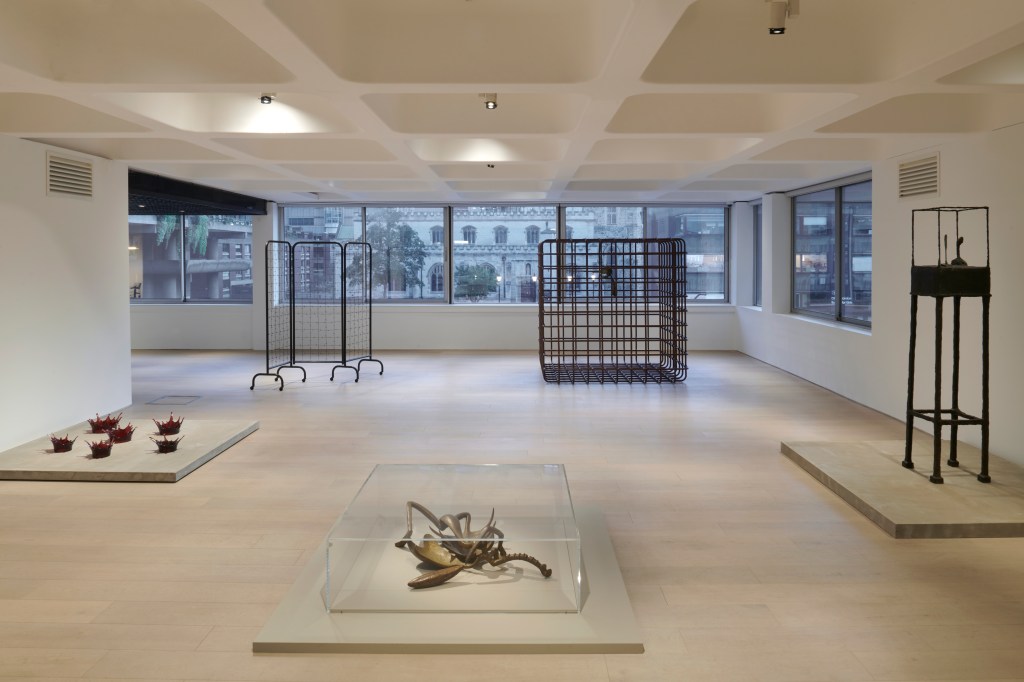
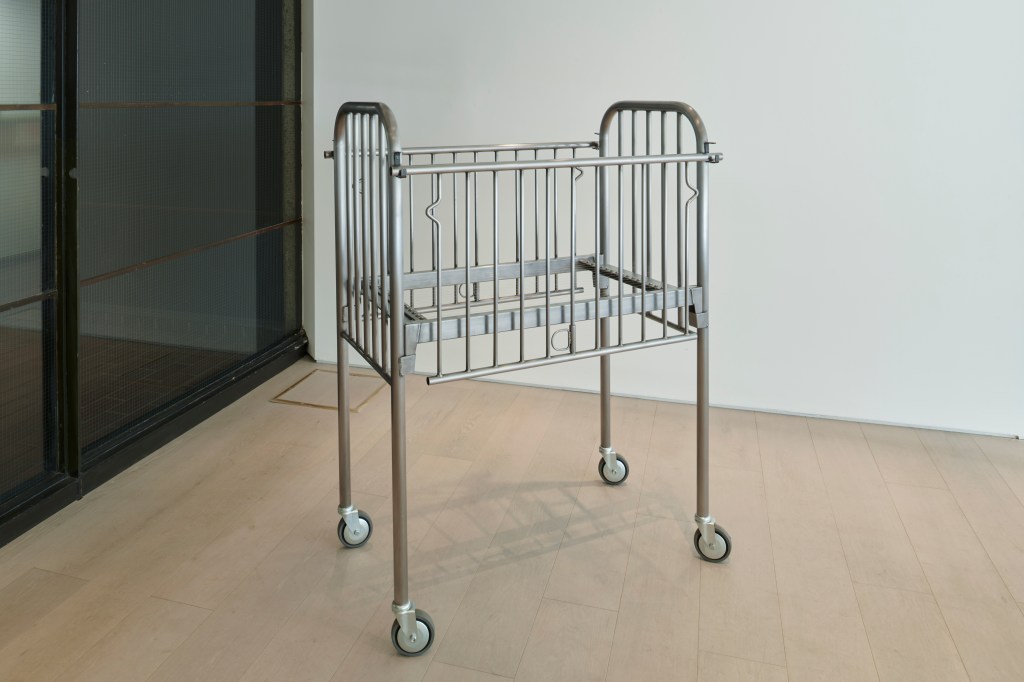
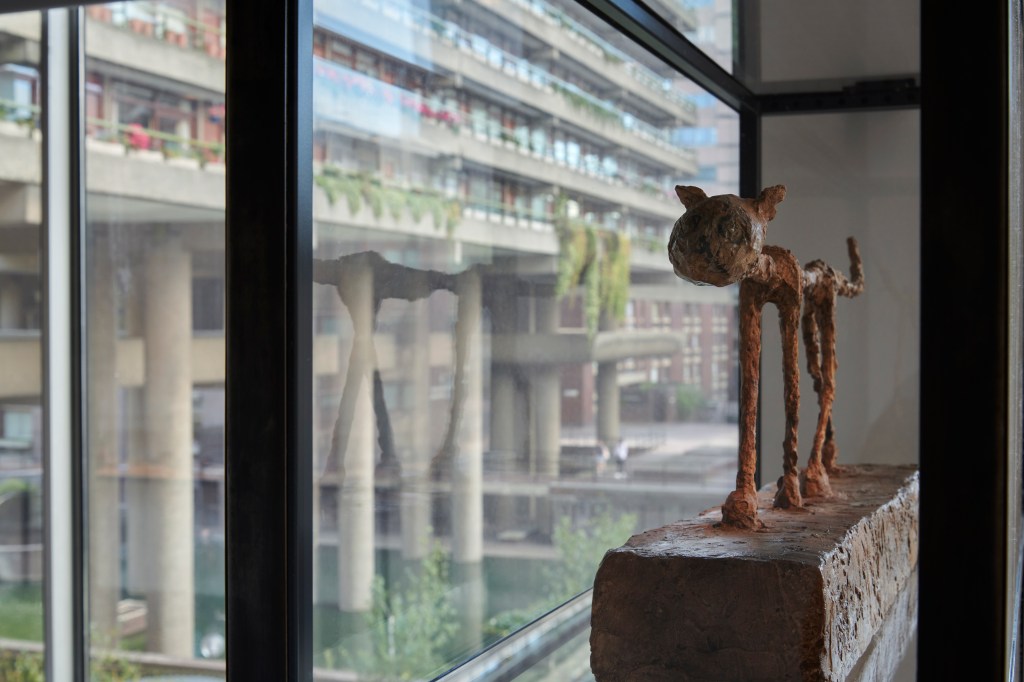
Beyond the large windows of the Barbican, Level 2, the dialogue between the two artists opens up. Having to walk a stretch of road alone, there’s no time to pull together a reasonable explanation, rather an imbalance that pushes my thoughts. I emerge from the lethargy, as yet not heard. I find myself in an emptiness, a silence, though not only mine. In a glass case, the alchemy of small, handmade objects bursts forth. Obstinate. They seem to have lost their way. Further on, an iron-barred crib (Incommunicado, 1993) ceases to reassure. Lying on the floor, next to Giacometti’s “Woman with her throat cut”, “A bigger splash”, red Murano glass coronets, falling to the floor as if slow boiling, evoke the presence of a violated body.
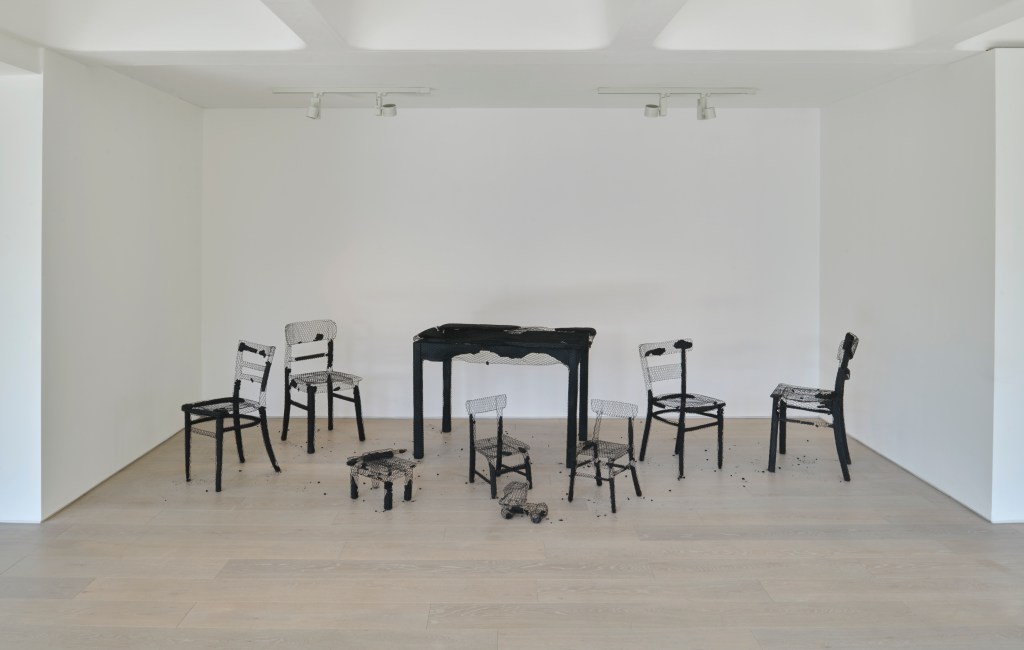
R: Mona Hatoum, Remains of the Day 2018. Wire mesh and wood, dimensions variable. © Mona Hatoum. Photo © White Cube (Kitmin Lee).
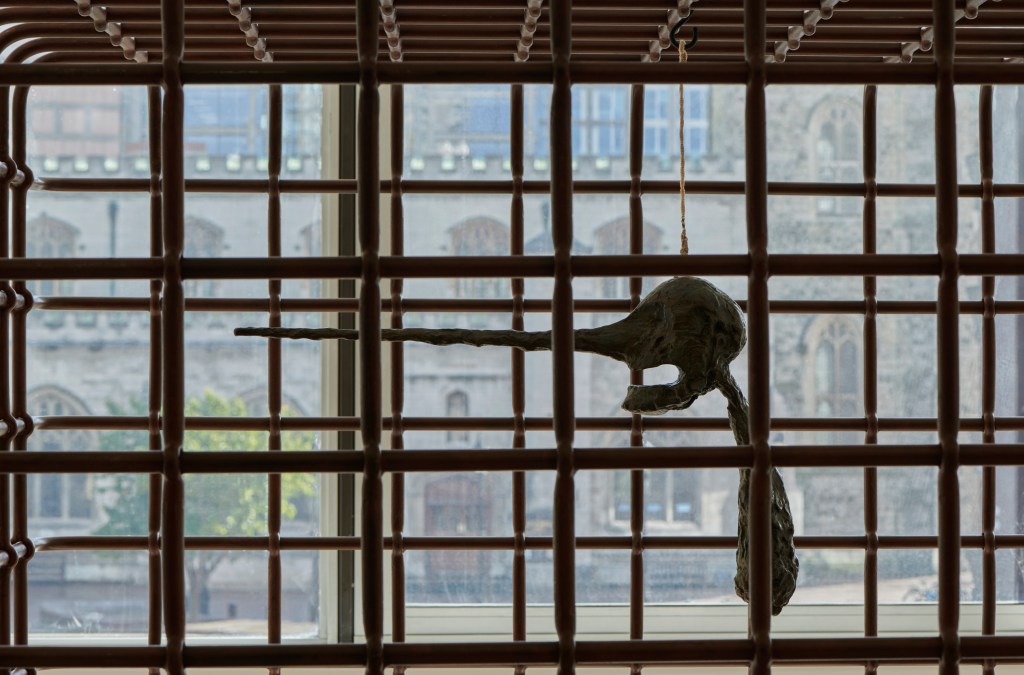
Giacometti (1901-1966) carried the weight of two World Wars’ destruction. That was the world emerged. Passionate of poetry and literature, Egyptian and Greek art, he lived in Paris during the 1930s. His sculptures reach us corroded, with an ethereal movement, in a caged framing. He captured within the bodies of his stylized figures the tale of a fragile humanity. The cage motif (“The cage,” 1950) became a fixed space, but also rather a window onto the outer world.
In Hatoum’s work “Divide” (2025), barbed wire replaces the fabric of a dividing screen. I wondered what kind of barbed wire it was, if I could move it elsewhere. Is it perhaps an illusion to think so? The story begins but does not end here—strange consideration in an era where the individual narrative is pushed forward. But we are also our collective transformations, right?
For both artists, there was attraction and distance from the Surrealist movement which, born after the First World War, found its guiding spirits in André Breton and Marcel Duchamp. Duchamp himself claimed that as imagination was driven by the deep unconscious: “The artist acts as a mediumistic being who, from the labyrinth beyond time and space, seeks his way out toward a clearing.”
In Hot Spot-stand (2018), the artist represents the Earth globe, with the borders of the continents in red neon, as if delineating a single global conflict. Today, it seems anticipatory, with our gaze turned toward conflicts, the climate emergency, and the events of death and destruction in Ukraine, Gaza, Sudan, Congo, and Ethiopia. And yet, in contrast, we have seen large crowds walk onto the roads, peacefully, for the end of the war, in a common feeling, in a sentiment of compassion.
Till soon,

 inbetween explorations
Lascia un commento