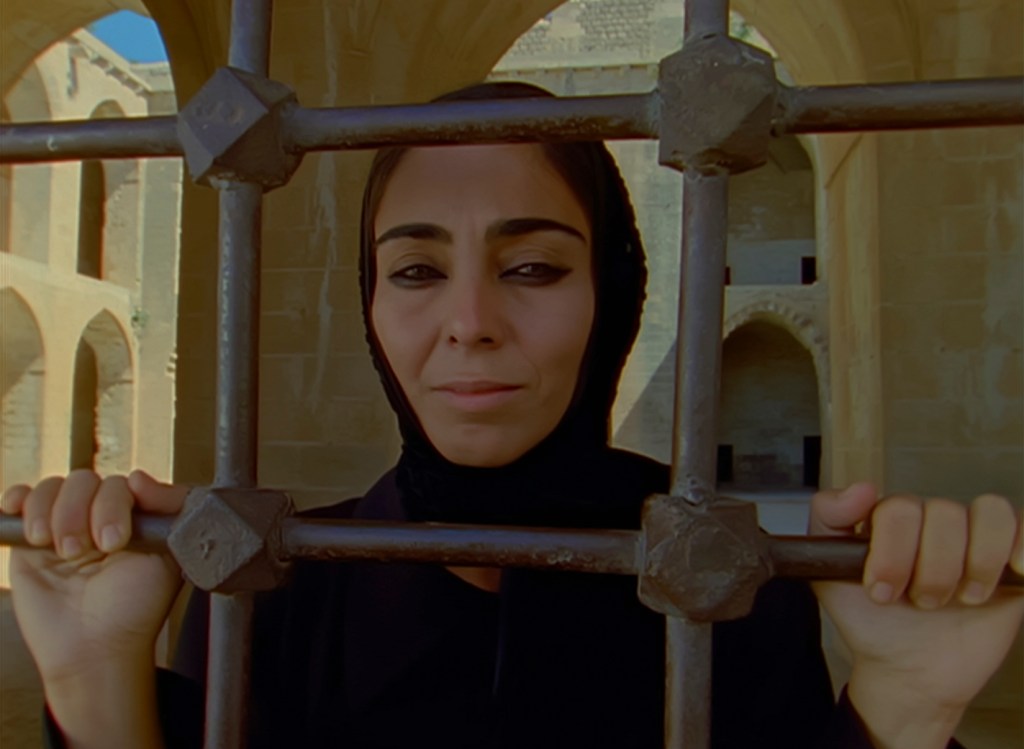
Shirin Neshat Soliloquy, 2000 Still da video Video installazione a due canali Copyright Shirin Neshat Courtesy l’artista e Gladstone Gallery.
At the PAC in Milan the exhibition “Body of Evidence” has recently closed — the largest retrospective ever held in Italy dedicated to Shirin Neshat, curated by Beatrice Benedetti and Diego Sileo. The show gathered over thirty years of the visual artist and filmmaker — a prominent figure on the contemporary art scene — showcasing nearly two hundred photographic artworks and around ten video installations, many of which are part of the world’s most prestigious museum collections, including MoMA, the Guggenheim NY, Tate Modern, and the Madre Museum in Naples.
Shirin Neshat was born in Qazvin, Iran. At just 17, in 1974, her family sent her to the United States to complete her studies — first in San Francisco, then at UC Berkeley — before she eventually settled in New York, where she has lived since 1993.
The multimedia and interdisciplinary artist began working with photography, later expanding into video installations, film and opera. In September 2025 she will direct Verdi’s Aida at the Opéra National de Paris. She won the Golden Lion at the Venice Biennale in 1999, the Silver Lion for Best Director at the Venice Film Festival in 2009 and the prestigious Praemium Imperiale in Tokyo in 2017.
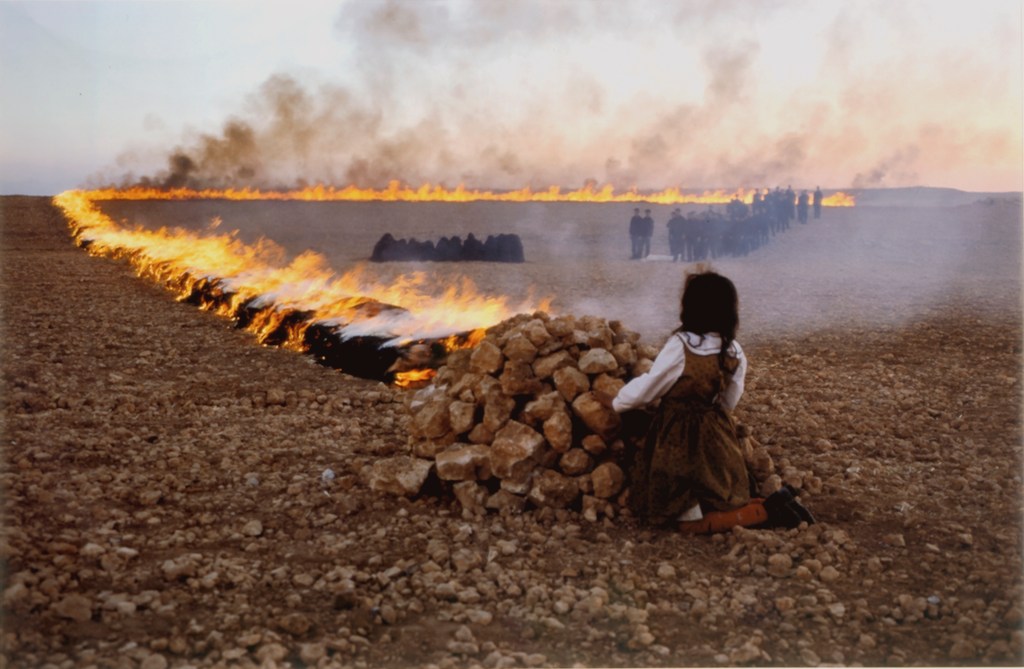
Shirin Neshat Passage, 2001 C-print Copyright Shirin Neshat Courtesy l’artista e Gladstone Gallery.
In 1979, Iran’s Islamic Revolution ousted the Shah and brought Ayatollah R. Khomeini to power, establishing a theocracy. It wasn’t until 1990 that Neshat was able to return to Iran, after 11 years away, witnessing the country’s rapid and radical transformation.
Women of Allah, her earliest and controversial photographic series, together with Unveiling catapulted her to international fame, a collection of female portraits created between 1993 and 1997. As she herself describes them: “They are faces of humanity.” The women, veiled and armed, are depicted with verses in Farsi inked with calligraphy across their faces and exposed hands — among them appears Neshat. The portraits reflect a deep interest in an unspoken dialogue, conveyed through the poetic lines of Persian writers painted on their skin.
From the outset, her art and memories draw us into places we wouldn’t expect to find ourselves onto. By following the artist and exploring her world, we learn to remain in dialogue. Her works raise questions about the contradictory role of women in society, gender rights and relationships, the limits of individual freedom and not least her own status as an exile (Soliloquy, 1999).

Shirin Neshat Roja, 2016 Stampa ai sali d’argento Copyright Shirin Neshat Courtesy l’artista- Gladstone Gallery.
In the halls of the Pavilion of Contemporary Art the multi-layered narrative unfolds, differently for each viewer, revealing a desire stronger than any form of censorship. I step into a booth and behind a curtain discover an installation that overlaps with the next — there’s no chronological order but moving images. Music flows, vibrations spread.
In the trilogy Fervor, Turbulent, and Rapture — presented with split-videos and split-sound works, side by side — Neshat traces the parallel journeys of a man and a woman. Their shadows move through desert landscapes, their missed encounters generating a perpetual tension. Separated by a black curtain, they gaze at each other unconsciously. The play of black and white — a distinctive trait of Neshat’s — speaks of the contradictions of contemporary society, which forces a duality, between who we are and how we appear.
In Fury, the central narrative focuses on the female body — as both object of desire and of violence. The artist inscribes verses by Iranian poet Forough Farrokhzad onto photographs. The video-installation explores the theme of sexual exploitation, through the story of a former prisoner.
In Passage (2001) Neshat reflects on the cyclical nature of life and sacred death rituals. The artwork shows a group of veiled women digging into the earth and chanting rhythmically, a procession of men and finally a young girl building a circle. Rituals, fire, land — elements that immerse us in an ancient culture. I’m reminded of the many parallels with our own Mediterranean heritage, surely an identity that cannot be defined by stereotypes, opposites or fixed interpretations.
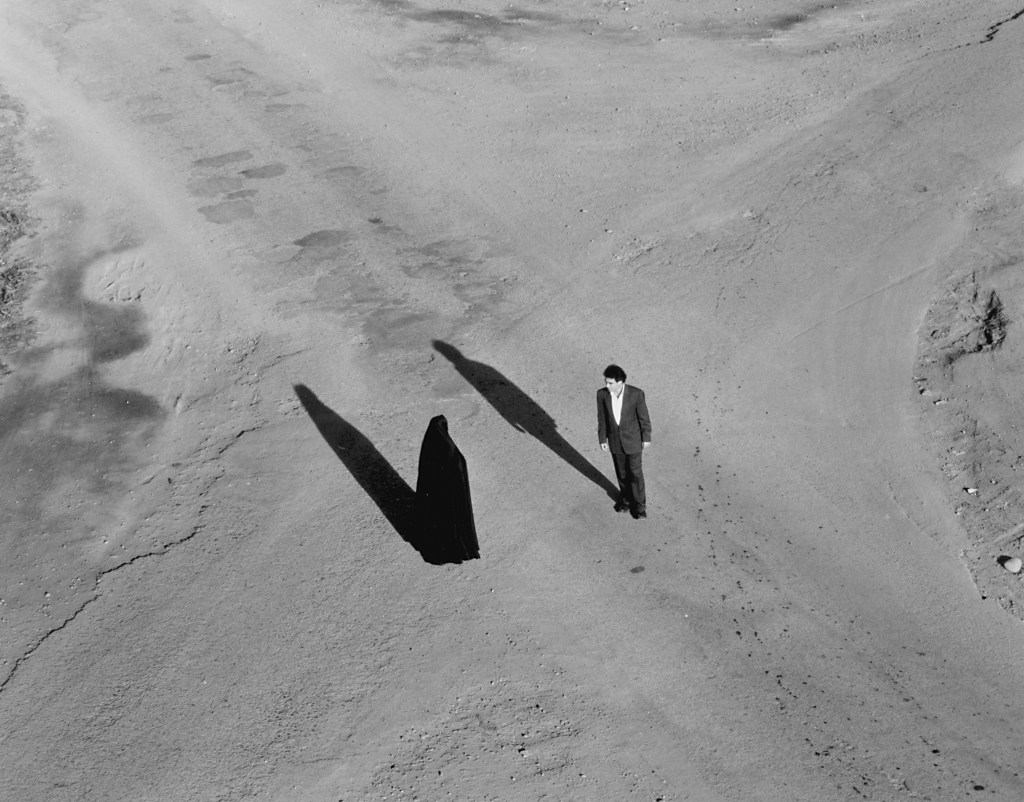
Shirin Neshat Fervor, 2000 Stampa ai sali d’argento Copyright Shirin Neshat Courtesy l’artista e Gladstone Gallery.
At an independent bookstore in town, among countless books on Iran, I came across one in particular that I loved: “Iran Under 30”, curated by Giacomo Longhi. It’s a literary collection, a lab of ideas where readers can dive in and out of stories by young writers. It offers a view of Iran’s current social landscape, deep into the roots and the energy of a new generation. The writers were selected by two of the most relevant figures in contemporary Iranian literature: Masha Mohebali and Mohammad Tolouei. Nothing in these stories is predictable.
Shirin Neshat’s voice —in the time we are living — opens us up to an array of nuances and enigmas that defy confinement within the self. In doing so she represents us all.
Till soon,

 inbetween explorations
Lascia un commento