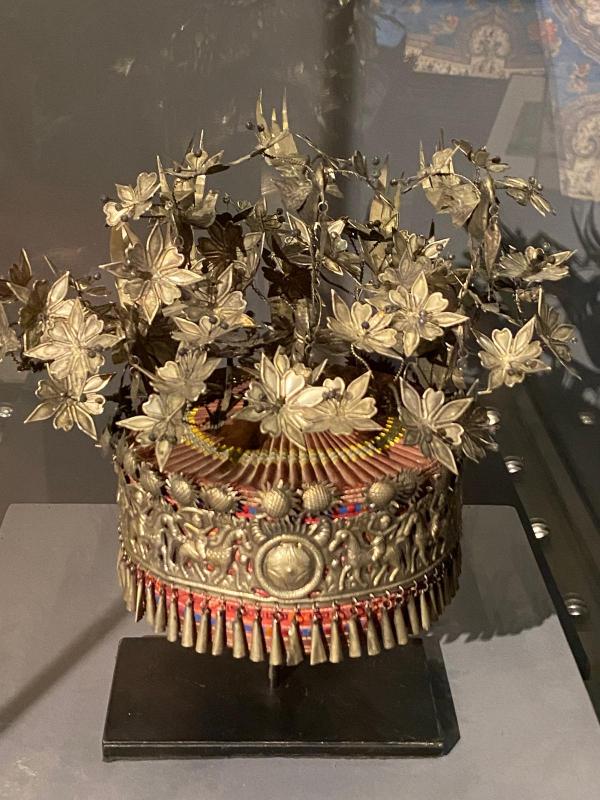
I’m thrilled to unveil the first episode of The Artist Residency, featuring Maria Teresa Papa. An undomitable explorer and friend, a background of life and studies at the Sorbonne, Università La sapienza Rome, Tel Aviv University, and most recently the Department of Arabistic Studies in Genoa. Here, you will find her essay on the exhibition at Palazzo Bianco. Her view is a precious artifact in the journey she shares.
“Credit: Comune di Genova – Direzione Musei – Civiche Collezioni Tessili.Photo by M T Papa.
The 13th verse of the Koranic Surah al-Hujurat, “The Private Rooms“, reads: “And we have made you peoples and tribes so that you may know one another.” This could be the essence of this precious exhibition, curated by Andrea De Pascale on the occasion of the donation by Laura Cucchiaro Barrai to the Civic Textile Collections, of garments and accessories from Central Asia and China. These artifacts’ brilliance is the result of the encounters and intertwining of millennial knowledge along the main paths of those caravans that, from the 2nd century BC until the mid-15th century, traversed lands, seas and rivers of China, the Eastern Mediterranean and the Indian subcontinent.
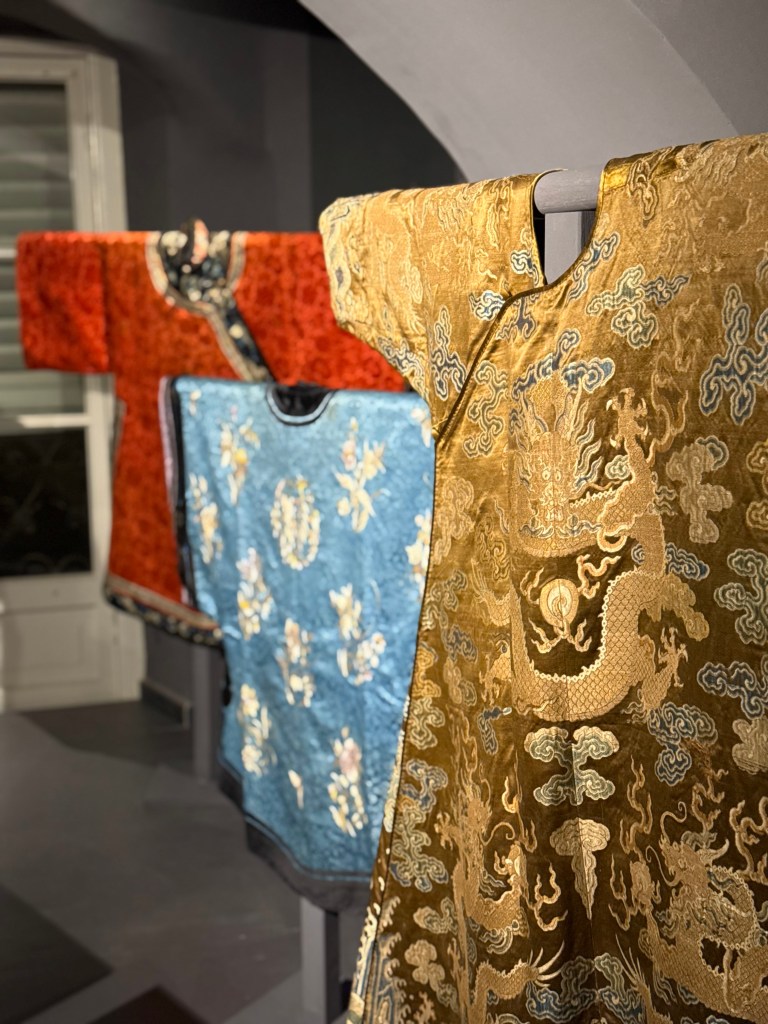
“credit: Comune di Genova – Direzione Musei – Civiche Collezioni Tessili; photo V. Castaldi”.
Each display case, with it’s refined contents, takes us back to the rare era of these extraordinary journeys, which could last two or three years. Along the road, the exchange was a wonder: precious textiles, ceramics, porcelain, spices, fine materials—all were traded. In ports. In caravanserais. Some of these even hosted libraries and their elegant architecture was the backdrop to an immensely fruitful meeting of knowledge: religious, musical, literary, linguistic, and artistic. “The world is a caravanserai,” wrote the Persian poet Omar Khayyam in the year 1000.

“credit: Comune di Genova – Direzione Musei – Civiche Collezioni Tessili; photo M T Papa.
In the small, quiet museum rooms, the noises, smells, and ancient confusions resonate from all the displayed objects: cotton or raw silk garments, patterned Persian silks, boccassini and damasks perhaps from Syria, camelot fabrics, lightweight wool fabrics made from goat or camel, or the marvelous bairan. This beauty is giddy. If undisturbed, we can allow ourselves to imagine the magician King Balthazar, of African origin, bringing the precious myrrh and follow echoes of Moors, Berbers, and Circassians. In the display cases, we see trays, linen makrama with multicolored silks and metallic threads, chapan from the Khiva region of Uzbekistan.

“credit: Comune di Genova – Direzione Musei – Civiche Collezioni Tessili; photo V. Castaldi”.
The technique used is the difficult and patient ikat method. In Uzbekistan, it is known as “abrbandi,” from the Persian word abr, meaning “cloud,” to indicate the vaporous look of the decorative patterns on the fabrics, which can be made of pure silk and velvet, or mixed threads of silk and cotton. An example of unexpected beauty is the paranja. It is a female garment, similar to a mantle, with long flap sleeves that are tied and hung down the back. Draped over the woman’s head, it enveloped her completely. It was worn with a rigid black veil, woven from horsehair.
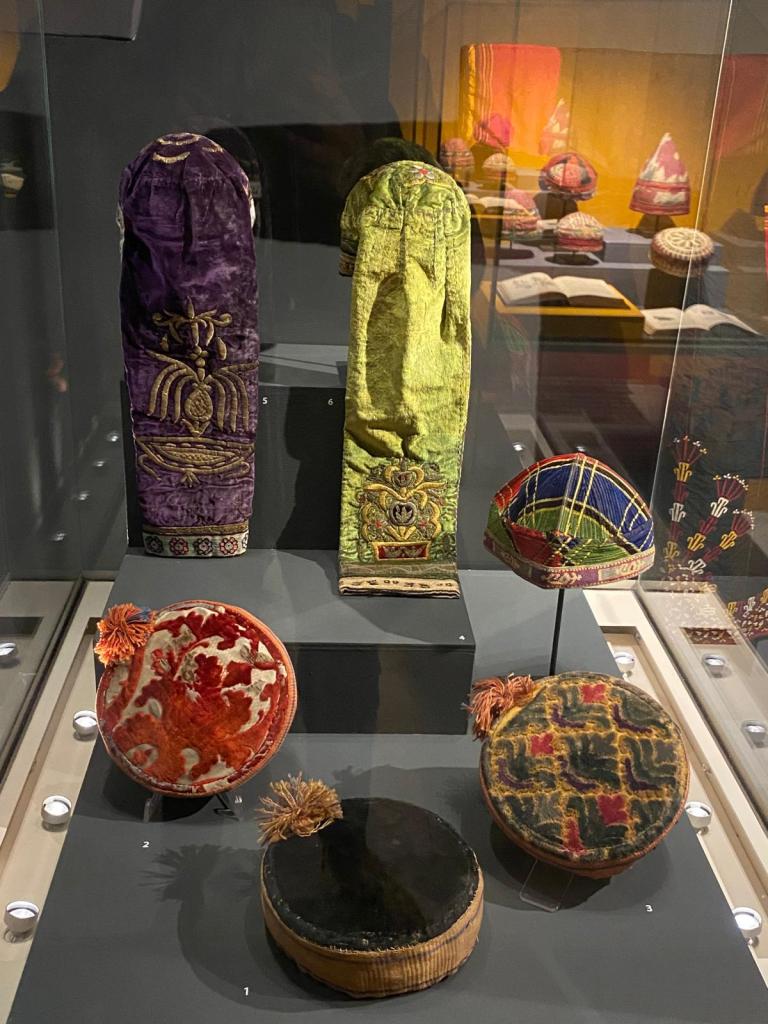
“credit: Comune di Genova – Direzione Musei – Civiche Collezioni Tessili; photo M T Papa.
The paranja was usually made from banoras, a handmade fabric with a gray, green, or blue silk warp and a cotton weft, with thin black stripes. The exhibited garment is embellished with embroidery and trimmings, fine details such as bone or mother-of-pearl buttons, tassels with beads, and metallic sequins. The marvel extends to the hats. The displayed examples mostly come from Bukhara, an important center for the art of zardozi embroidery (from Persian zar, meaning “gold,” and dozi, meaning “sewing”). We know that only men executed these embroideries because it was believed that women’s breath could dull the gold. The combination of colors is superb.
The simpler headpieces are paired with those adorned with long tails, enriched with the finest embroidery, beads, and sometimes even small mirrors. To protect children’s heads from evil spirits, small amulets such as blue beads, owl feathers, and woven threads representing snakes were added to the headcovers. Shapes, colors, and designs conceal hidden, fundamental meanings.
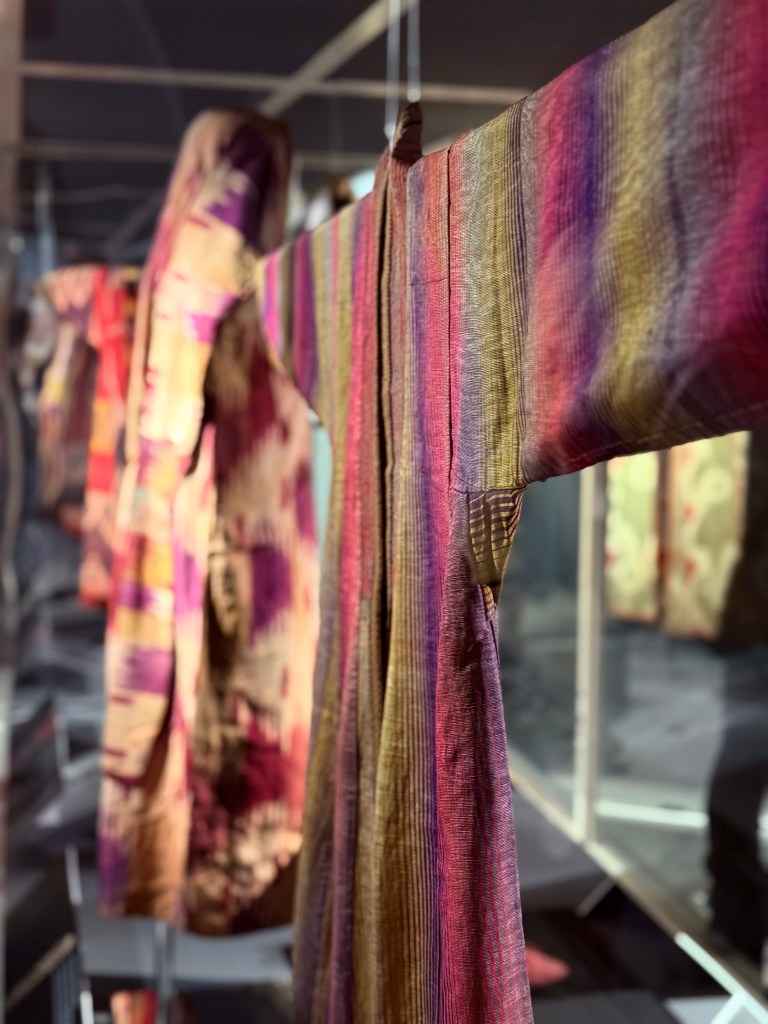
“credit: Comune di Genova – Direzione Musei – Civiche Collezioni Tessili; photo V. Castaldi”.
Equally fascinating is the collected photographic material of the Russian chemist and photographer Sergei Mikhailovich Prokudin-Gorskii and of the Italian missionary Leone Nani. These are all elements in conversation, skilfully linking together vast plains and great rivers, Judaism, Islam, and Christianity, the Greeks of Alexander the Great and Persia. The display cases gather this choir. And it is clear that true beauty can only result in the together interwoven threads of humanity.
Maria Teresa Papa.

 inbetween explorations
Lascia un commento