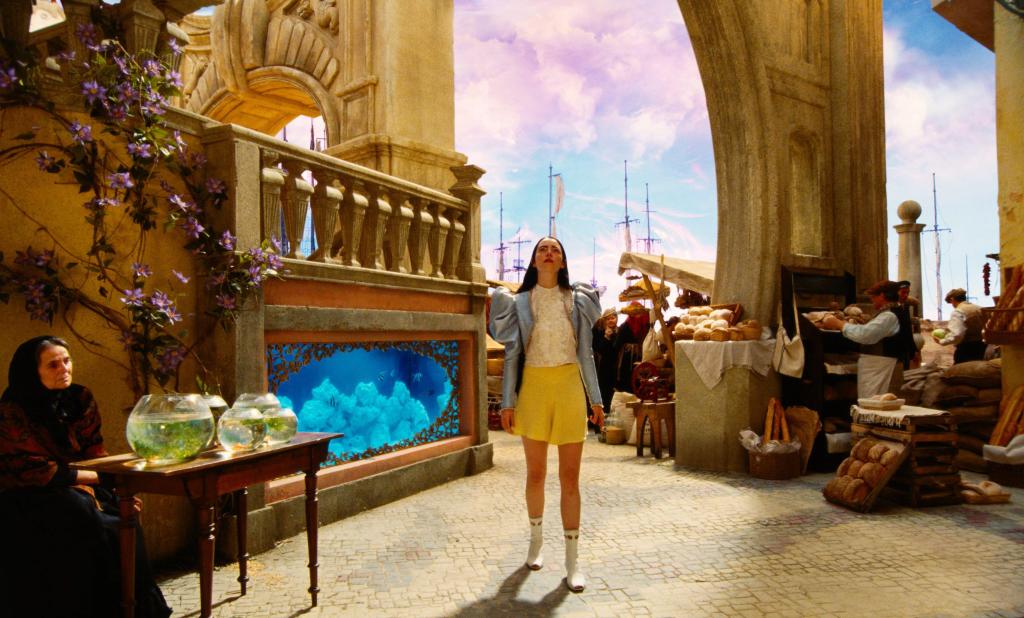
(Credit Image: Entertainment Pictures / Alamy Stock Photo)
The story and its characters seem to be outside of a real historical context but contemporary in their expression. The imaginative, dark-gothic, baroque set design, the incredible costumes, the photography and music, all of this resonates.
Adapted from the novel written by Scottish writer Alasdair Gray in 1992. Winner of the Golden Lion in Venice, Golden Globe for Best Film and Actress: Emma Stone, the film won 4 Oscars: Best Actress, Best Costume Designer, Best Production Design and Best Make up & Hair Styling.
Poor Things opens up with the premonitory mystery of a night sky, in Victorian London, where a woman is about to throw herself from a bridge. We then find her miraculously brought back to life by the renowned surgeon “God-win Baxter,” who performs an experiment on her, transplanting the brain of the fetus she was carrying. It is somehow the asynchronous relationship between the child’s brain and the woman’s body that sets the rhythm of the narration, in which, Bella-Emma Stone, begins to take her first unsteady steps, staggering in search of herself, in continuous experimentation.
Bella soon leaves her father’s house, a gilded cage, and embarks on a futuristic journey around the world, accompanied by Duncan Wedderburn, a philandering lawyer, with whom she will have an affair. They travel through continents and European cities, touching Odessa, Lisbon, Alexandria in Egypt, and Paris. Soon Bella’s journey will continue without Duncan, who is left in Paris on the edge of a bench, on the brink of financial collapse and, above all, a nervous breakdown!
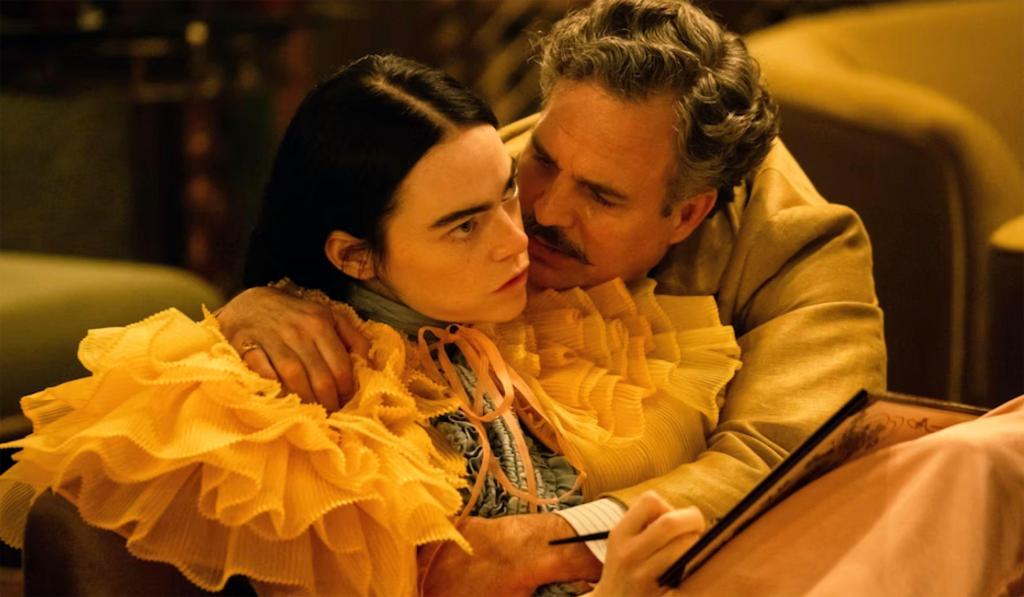
The costumes are deeply connected to the story, Bella’s dresses evolve, they are a manifestation of herself and never constriction; it’s no coincidence that she doesn’t wear typical period bustiers but they are often overlapping or seemingly incomplete. The body is therefore the place of knowledge and care, if you will. Revolutionary for social conventions, the morality imposed by the well-thinking society of the time.
Costume designer Holly Waddington, in her interviews, has talked on the articulated nature of the process: how the decision was made not to adhere to a Victorian period-drama scheme, but rather to let the creative play of the clothes flow free, in a way that seems only apparently discordant though perfectly in tune. The inspiration and exchange with the world of art and fashion of the late 1800s and early 1900s and the multiple references: Surrealism and Avant Garde, German Expressionism, J. Singer Sargent but also references to Georgia O’Keeffe and Egon Schiele, are some of the multiple elements that have contributed and inspired the glorious costumes.
I’ve found Bella’s moment in Lisbon memorable, with her legs bare in light yellow shorts, a shiny blue texteured silk jacket with big puffy sleeves, white ankle boots and futuristic sunglasses. Whereby the reference is once again personal rather than referred to a period or style.
The use and contrasts of colors are superb, in both photography and costumes: the Bolero of Mango yellow silk ruffles, or even what the costume designer, Holly Waddington herself has defined as the “condom coat,” a latex coat, off-skin, that Bella wears in a snowy, early last century Paris, right in front of the brothel that will be home for some time: somehow naked in that space-time.
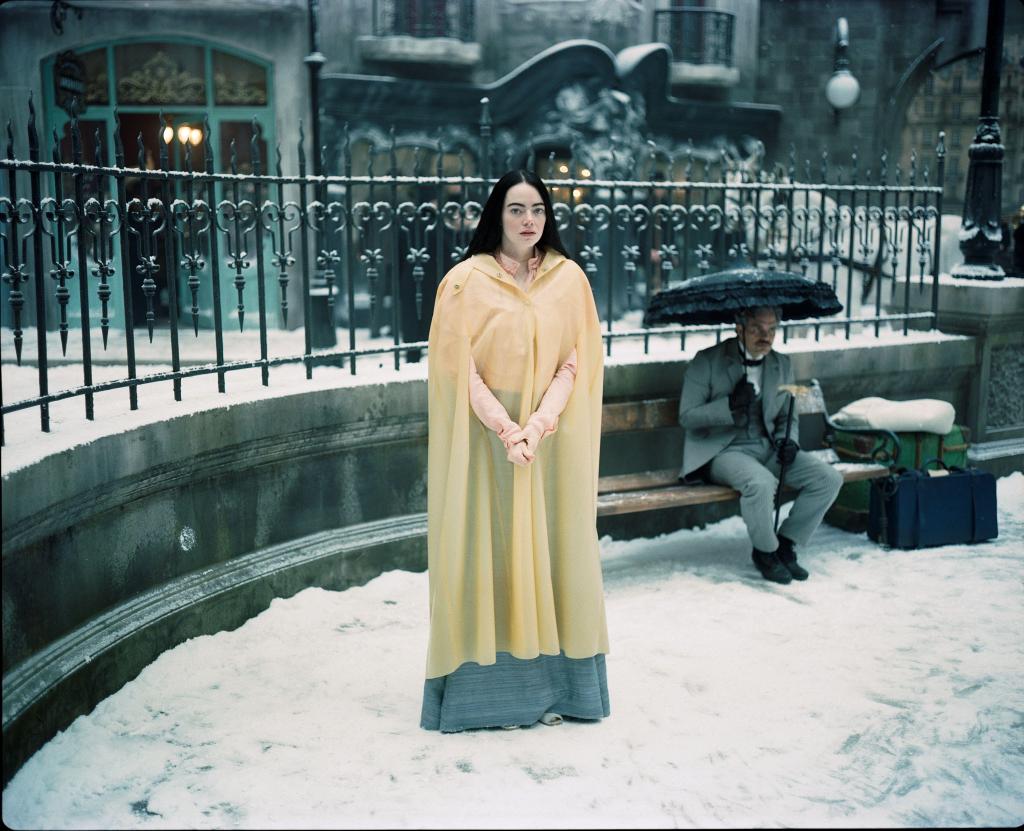
In that brothel, the characters and clients, who almost seem like caricatures from a satirical comic, and Bella’s clothes, speak to us about her body, her sexuality, and how all of this is self-love and as such, a necessity.
Bella’s journey continues, and much more happens, during and after, when she returns home, and always and once again, the costumes harmoniously enhance the story.
In London, the exhibition “Sargent and Fashion” has just opened at the Tate Britain.
J. S. Sargent created some magnificent portraits, forever changing the perception of the women he portrayed, through their clothes, and bridging the gap between style and fashion, identity and personality.
As if how, true style comes from a high desire?
Till soon,

 inbetween explorations
Lascia un commento