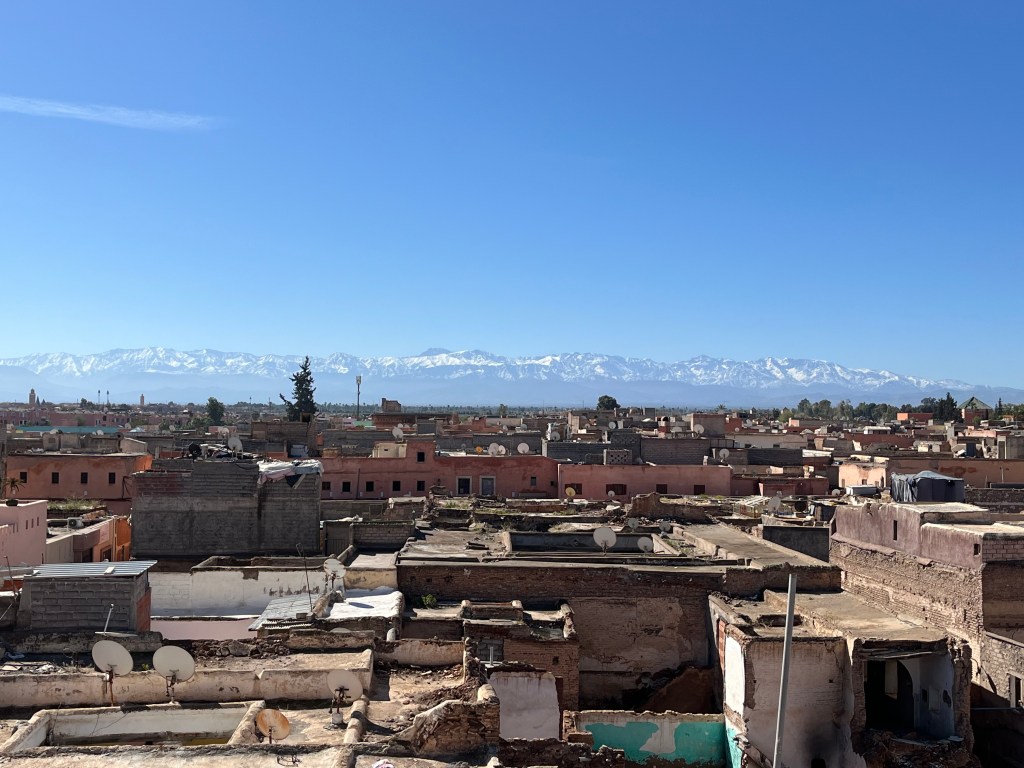
Upon our arrival, the ocher light of the evening holds an anticipation.
I shut my eyes and see, in a still frame, as our taxi speeds through traffic, just before the end of Ramadan.
Among the many faces encountered here, one in particular seems familiar to me.
Madhi and Youssef open the door to our Riad in the Medina of Marrakech. Madhi is tall and lanky. I can’t help but noticing his resemblance to John Turturro (beloved). Discreet in gaze and manners, his dream, conversely, is to visit Bologna and its University. While Youssef keeps his distance. Ambiguous looks, inscrutable kohl-lined eyes, a quick step and he’s gone.
But if it’s true that places are also the people you meet, what brings me here and how can I enter it with the eyes of someone else?
In the novel “Confessions of a Caliph” by Hassan Aourid, found in an independent bookstore in town, the story of the powerful Umayyad Caliphate of Cordoba in the Muslim Spain of the 10th century is told. The book narrates the strong bond between Morocco and this Arab dynasty in Spain, in the city known as Al-Andalus or Cordoba.
The splendor was shared between the two limits of the same world: the East of the Maghreb and Spain in the Mediterranean, a center and crossroad of religions, trade, and cultural intersections ever since.
But the place was also one where boundaries met, of possible convergence between civilizations: Arabs, Berbers, Goths, Muslims, Christians, and Jews. All and none were foreigners to that land, because stories are born with the exodus aren’t they?
The Caliph Al-Hakam, near to death, confides in his loyal Ziri. Revealing his secret, in the folds of a life… “However, as a young boy, I realized another truth that is rarely revealed…a truth that has rooted in my thoughts and inhabited my heart…” “…And that we live by the sword and we will die by the sword.”
Despite having lived as a warrior, heir to a dynasty that assigned his role and the consequences, he understands that the ultimate goal may be something else…not just strength and combat, but knowledge, art, and mastery of crafts. Aourid writes.
Thinking of Al-Hakam, I recall the teaching of the sword, studied in the yogic practice of Kundalini. This is the thread that binds and divides us. If in the space between birth and death there is our personal attempt, the sword becomes a symbol and instrument to our vital energy, to sever what distances us from our being. Whatever legacy we inherit. Today, the freedom to be oneself is our greater good, but being free also entails to go beyond, creating relationships of coexistence in our societies.
Paola Zehender ph credits
On the first evening, in the Medina, we spend time with the guide, who will cook for us a spicy Tanjia in the the ancient hammam.
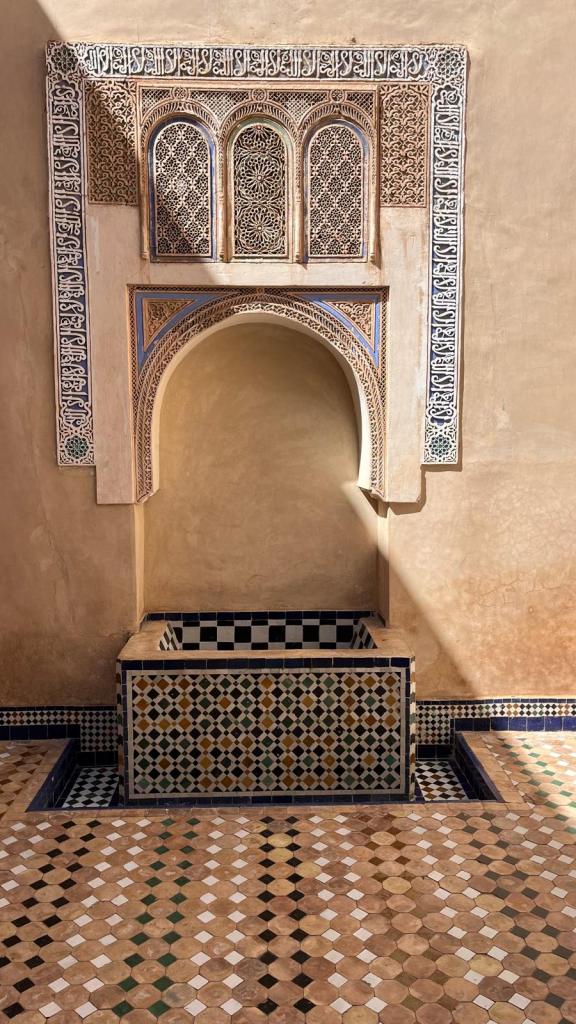
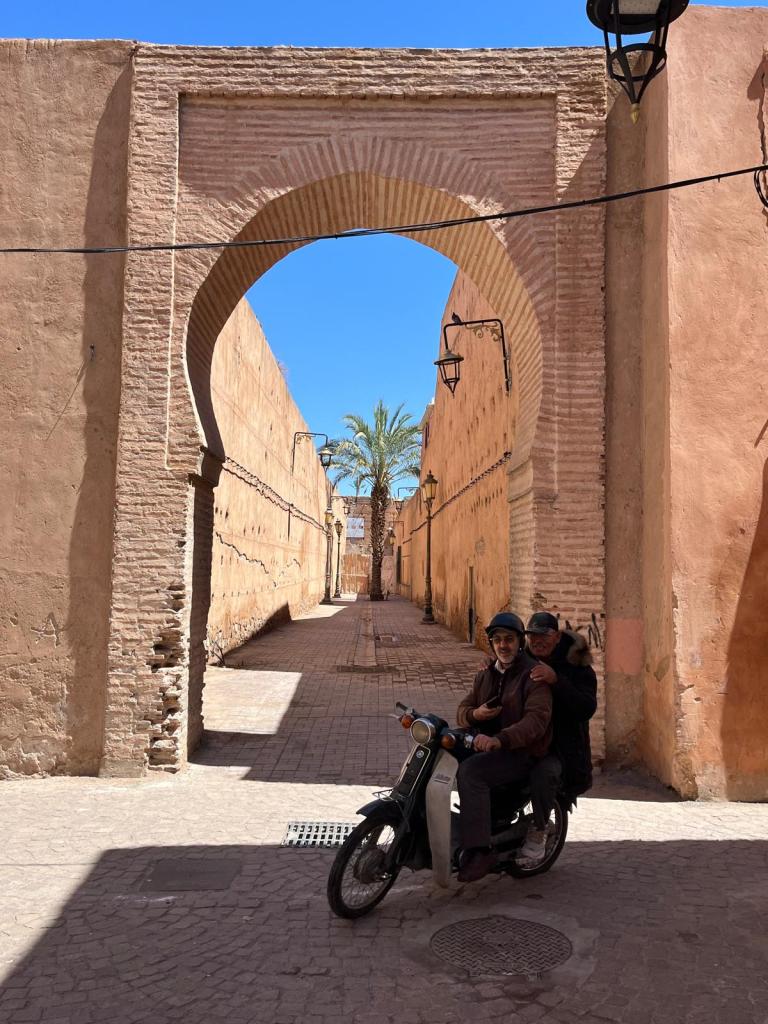
The next day, we visit the city’s historical sites: the Djemaa el Fna square, the Souk, the Koutoubia Gardens, the Saadian Tombs, the Bahia Palace, and the Ben Youssef Madrasa, known to be the oldest Koranic school. Spotting everywhere traces of sophisticated juxtaposed art: mosaics, refined Berber and Arab stuccoes, portals, secret gardens and courtyards.
We have dinner in the Sidi Youssef Ben Ali district. There we meet M.me Oulami, President of the El Amane association. She will tell us about her life on the edge and how, over the years, she has managed to be the keeper of young students and women victims of violence.
The next morning, we depart for the Argan region. We skirt the High Atlas and after a stop in Taroudant, continue towards the Souss Massa National Park, on the Atlantic coast south of Agadir. An endless chain of small villages and markets passes before us. We stop in Sidi Kaouki, a fishing village. The weather is adverse, a storm and strong winds await us. The next day we leave for Essaouira, an ancient Portuguese colonial city, born on the ocean.
We meet Yassin, in his small boutique, in the Medina. He plays for us the ancient instruments of sub-Saharan Africa, introducing the Gnawa music, and enraptured by his music, he is soon oblivious to us.
Paola Zehender Ph Credits
Before returning to Marrakech, we make a stop in the village of Imin’Tlit, visiting the Tamounte Women’s Cooperative of Argan oil. Strange how time marks a crystallized rhythm on these remote hills. Long and solitary is the road to get there, almost as if protecting the small community that lives there.
Back home, I returned to that same bookstore, and on the advice of the patient bookseller, I immersed myself in a new precious novel: “La Vie lente” by Abdellah Taia.
The protagonist is Mounir, an intellectual and writer, who has expatriated to Paris from Morocco. The poignant portrait of a young homosexual boy, searching for himself and the dialogue that intertwines with his existence in Paris over recent years, brings traces and memories of his past life tied to the present one. The young Mounir’s gaze is only apparently blurred, when the silence of solitude becomes unbearable noise.
I keep thinking. Time and words create circuits through which thoughts pass. Such is the Journey?
See you soon,
Paola Zehender

 inbetween explorations
Lascia un commento